A House on a Hillside: How the House of the Virgin Mary Found Its Way into Beneath Mediterranean Skies


Every stop on Olivia and Lance's Mediterranean itinerary earned its place in the story for a reason, but few moved me the way Kusadasi, Turkey did. Most travelers who dock there head straight for the marble streets of Ephesus, and rightly so. But a few miles up a quiet, pine-covered hill above the ancient city sits a small stone chapel that carries a different kind of weight entirely: the House of the Virgin Mary.
A Place Built on Tradition, Not Certainty
What struck me most when I first visited, and what I wanted to carry into the novel, is how honest the House is about its own uncertainty. There's no definitive proof that Mary lived out her final years in this modest structure above Ephesus. What exists instead is a long, layered thread of tradition: early church historians who placed the Apostle John in Ephesus not long after the crucifixion, a scriptural passage in John's Gospel where Jesus entrusts Mary to John's care, and centuries of pilgrims and scholars who followed that thread to this particular hillside.
Archaeologists who examined the site in the early 1900s, working for the French, Italian, and British governments respectively, each came to a similar conclusion: the foundation likely dates to the first century, even if the structure above it was rebuilt later. None of them could say it with certainty. And somehow that unresolved quality, faith reaching toward history and history reaching back, is exactly what made the place feel right for a story about two people trying to figure out what they actually believe, about love and about themselves.
Writing Around a Sacred Space
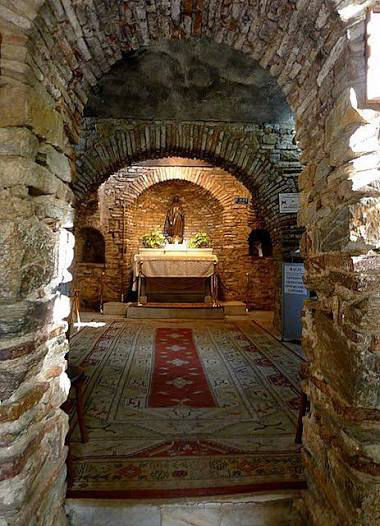
I knew early in drafting the Kusadasi chapters that I didn't want to turn the House of Mary into a plot device or a tidy metaphor. Sacred spaces like this deserve restraint. So instead of forcing a big emotional turn inside the chapel itself, I let the setting do quieter work: the hush that falls over a group of strangers stepping under that low stone archway, the candlelit interior with its worn altar, the sense that whatever people believe walking in, they tend to walk out a little softer.
That contrast, the noise of a cruise excursion giving way to sudden stillness, became a rhythm I leaned on throughout the book. Olivia and Lance carry their own baggage up that hill, and the House doesn't resolve it for them. It just gives them a moment of quiet long enough to hear themselves think.
The Wishing Wall

Just past the chapel, there's a long stone wall covered in small scraps of white cloth and paper, tied there by visitors leaving prayers and wishes behind, regardless of their faith or lack of one. I stood at that wall only once, but it's the kind of sight that stays with you: thousands of quiet hopes fluttering in the breeze, left by people who will never know if anyone else's wish came true.
It felt like the right image to bring into the novel. There's something universal about it, a gesture that has nothing to do with denomination and everything to do with hope. I won't spoil how it shows up in the story, but readers who've been to that wall themselves will recognize it right away.
The Sacred Springs

Below the chapel, ancient wells still feed a row of small fountains where visitors stop to drink or fill bottles to carry home, believing the water carries a healing quality passed down through the site's long history. It's a small ritual, almost domestic in scale, after the grandeur of Ephesus below. That contrast between monumental history and small human gestures is something I tried to weave through the whole Mediterranean itinerary in this book, and the springs at the House of Mary were where that idea first crystallized for me.
The Baptismal Pool

Before you ever reach the chapel itself, you pass a small keyhole-shaped pool tucked into the garden near the entrance. It's easy to walk right past it on the way to the main attraction, but I found myself lingering there longer than I expected. Tradition holds that this was once a baptismal pool used by the earliest Christian community that gathered around John and Mary in Ephesus, a place where converts were baptized in relative seclusion, away from Roman eyes. Some later scholarship has questioned that identification, suggesting it may simply be a Byzantine-era cistern. But the story has stuck, the way these things tend to at sites this old, and pilgrims still pause there and toss in a coin or a quiet wish on their way up the path.
I liked the idea that even the questions surrounding this site have their own smaller, unanswered questions nested inside them. It felt true to how faith and memory actually work, layer after layer, each one a little less certain than the one below it, and yet the whole structure still stands.
A Shrine Shared by Two Faiths

What deepened my respect for the place even further was learning how far its reach extends beyond one religion. Three popes have made the pilgrimage up that hillside: Paul VI in 1967, John Paul II in 1979, and Benedict XVI in 2006, who held an open-air Mass on the terrace during his visit to Turkey. Each visit reinforced the shrine's standing in the eyes of the faithful, even though the Catholic Church has never officially confirmed the house as Mary's home.
But the detail that stayed with me longest is this: every August 15th, on the Feast of the Assumption, Christians and Muslims arrive together to pray at the same small stone house. Mary holds a place of deep reverence in the Quran as well as the Gospels, and for one day each year, two faiths that so often make headlines for their friction instead share a single quiet hillside in devotion to the same woman. That image, of common ground found in the most unexpected of places, felt like something worth carrying into a novel about two people from very different worlds trying to find their own common ground.
Why It Belongs in This Story
Beneath Mediterranean Skies is, at its core, a book about people navigating uncertainty, in their careers, their pasts, and each other. The House of the Virgin Mary, a place that has survived centuries on the strength of tradition rather than proof, felt like the perfect quiet center for that theme. It doesn't ask visitors to believe anything in particular. It only asks them to be still for a moment.
I don't know if this is where Mary lived out her years. No one does, not really. But the thought of walking the same ground that she possibly did is enough to give anyone pause.
That's the same thing I hope this book asks of its readers.
Beneath Mediterranean Skies, Book 2 in the Uncharted Horizons series, releases October 1.

Comments