How a Harbor in Crete Became a Turning Point. Why Crete Made the Book

When I first mapped out the itinerary for Beneath Mediterranean Skies, Crete wasn't on the page. The cruise Olivia and Lance take was built around the stops that mattered most to the story I already knew I wanted to tell: Naples and the Amalfi Coast, Athens, Mykonos, Santorini, Venice, and the long, golden run through Florence and Chianti. Crete wasn't part of that plan. It found its way in later, and honestly, it found its way in because I couldn't stop thinking about a morning in Chania.
The Harbor That Wouldn't Leave Me Alone
My wife and I spent a morning walking the old harbor in Chania, on Crete's northern coast, and it is one of those places that photographs well but somehow still undersells itself. The Venetian lighthouse stands at the mouth of the harbor like it's been keeping watch since the 1600s, because it has. The promenade curves around in a crescent of pastel buildings, faded ochre and rose and blue, stacked shoulder to shoulder in that unmistakable Venetian style. The Hassan Pasha Mosque sits right on the water with its low dome, a reminder that this harbor has passed through Venetian hands, then Ottoman, then Greek, and worn every layer of that history without smoothing any of it away.
We sat at one of the waterfront restaurants, Zepos, with the harbor stretched out in front of us, mosque dome and pastel buildings framed across the water. Souvlaki skewers, tzatziki, grilled pita, a plate of fries, a glass of wine, and later small carafes of raki set out on the table with the little shot glasses beside them. I remember thinking that this was exactly the kind of place a reader would want to walk through with a character. Not because it was picturesque, though it was, but because it felt lived-in. Back behind the harbor, in the square by the fountain, a street musician had a mic and amp set up and was singing to a small crowd, and horse-drawn carriages waited along the old fortress wall for anyone who wanted a slower way to see the town. There's a difference between a place built for tourists and a place tourist are lucky enough to be let into, and Chania is the second kind.
Then something happened that I didn't plan for and couldn't have staged if I'd tried.
A Ceremony I Wasn't Expecting
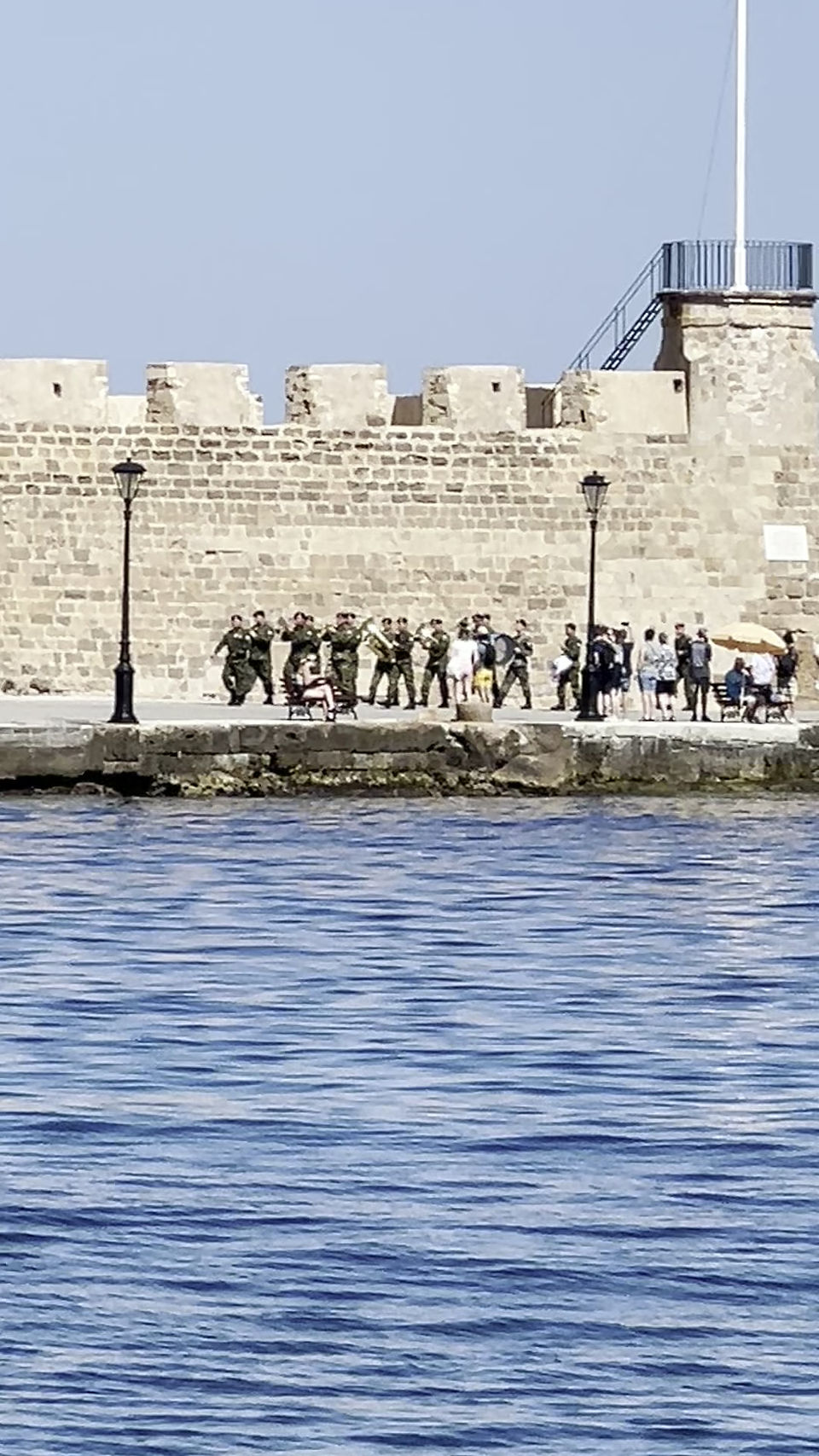
While we were there, we came across a military commemorative ceremony out on the seawall near the lighthouse. A long formation of Greek soldiers in camouflage stood alongside sailors in white dress uniform, rifles held at rest, facing out toward the water where a tall ship sat anchored near the lighthouse. Off to the side, a cluster of British and allied officers stood in navy dress uniform, rows of medals on their chests, several women among them, all of them watching the same direction as the formation. It was gathered to honor the veterans of the Battle of Crete, fought in 1941 when German paratroopers invaded the island and Cretan civilians, alongside British, Australian, and New Zealand forces, fought back with a ferocity that became legendary. Standing there watching that ceremony unfold, completely unplanned, completely real, I felt the same thing I've felt on a handful of other stops over thirty years of cruising: this is a scene. Not a photo opportunity. A scene, with weight and history and people in it who meant something.
I didn't write that down as book material at the time. I just remembered it. That's usually how it works for me. The moments that end up in the Uncharted Horizons books aren't the ones I go looking for. They're the ones that stay lodged in my head months or years later, the ones I catch myself describing to someone at a dinner party and realize I still haven't gotten the volume of my own reaction right when I tell it out loud.
Finding the Reason to Use It
Here's the thing about writing a series where "everything is real except the names and the story": a great location isn't enough on its own. Chania earned its way into the manuscript, but I still needed a reason for Olivia and Lance to be standing in it, and I needed that reason to do real work for the plot, not just give me an excuse to write about a lighthouse.
That's where the Ravenna deal came in. Lance's job, the one he's spent most of the book being cagey about, catches up to him mid-cruise. A crisis in Ravenna escalates to the point that the company sends a private plane for him, and he has to say goodbye to Olivia at the Crete port without knowing for certain whether he'll make it back to the ship in time. That uncertainty, that image of him walking away not sure if he's coming back, does something the itinerary alone never could. It puts a crack in the version of the romance the reader has been comfortable with up to that point.
And it leaves Olivia alone in Chania. She has the day to herself, lunch, the shops along the harbor, time to sit with the version of this relationship where Lance might just not show up. That's when she comes across the ceremony. A woman working through her own uncertainty about whether someone is coming back, standing at a memorial for men who didn't come back, in a country that has never stopped honoring them. I didn't have to reach for that parallel. It was sitting right there in the actual history of the place.
Why the Order Matters
The other piece that fell into place once Crete entered the itinerary was Athens. In the original outline, the reunion beats, the bus mix-up, the stadium scene, all happened as part of an Athens chapter where Lance and Olivia are already back together and dealing with an entirely different kind of misunderstanding. Once Crete became the point where he leaves, Athens became the point where he comes back. He's waiting for her at the pier when the ship arrives, and only after that reunion do the existing Athens beats play out, now with the tension of the goodbye still fresh instead of buried under new plot.
That's the part of this process I find myself explaining to other writers when they ask how autobiographical the series really is. It's not that I lift a vacation and drop it into a manuscript. It's that a real place, walked through once, with no intention of ever writing about it, sometimes hands you a piece of structure you didn't know you needed. Chania gave me a harbor worth describing. The ceremony gave me a reason the harbor mattered. And the Ravenna deal gave me a reason Olivia would be standing there alone long enough to notice.
Crete wasn't in the outline because I hadn't yet figured out what the book needed. It turned out the book needed exactly what that morning in Chania had already given me, three years before I sat down to write it.

Comments