Walking Through Time: Our Day at Ephesus Turkey (Kusadasi)


There's a moment on every great cruise itinerary where the ship pulls into port and you realize the history books are about to become real. For my wife and me, that moment came in Kuşadası, Turkey, with the town's name spelled out in giant white letters on the hillside above the harbor, guarding the base of a hill topped by a gleaming statue of Atatürk. From the rail, it looked like just another pretty port. What we didn't know yet was that a short drive inland was waiting to remind us why we keep doing this.
Meeting Valkan
Every great excursion lives or dies by the guide, and we hit the jackpot with Valkan. He had that rare gift of making 2,000-year-old stones feel like they happened last week. Instead of rattling off dates, he told stories, about the people who walked these streets, the arguments they had, the lives they lived. By the end of the day, Ephesus wasn't a ruin to us anymore. It was a city we'd visited.
The Grand Theatre

Our first real stop inside the ancient city was the Great Theatre of Ephesus, carved into the hillside and built to hold roughly 25,000 people. My wife and I stood at the bottom looking up at those stacked rows of seating, and it's hard not to feel small. This is the same theatre where, according to the Book of Acts, a riot broke out over the silversmith Demetrius and his trade in silver shrines to Artemis. History and scripture and stone, all sitting in the same spot.
Marble Street and the Walk to Remember

From the theatre, a long marble-paved road stretches toward the heart of the ancient city. Two thousand years of feet, ours included now, have worn a shine into those stones. Walking it, flanked by broken columns and toppled capitals, gives you a real sense of scale. This wasn't a village. This was a major Roman city, with paved streets, public buildings, and enough foot traffic to polish stone.
The Temple of Hadrian and the Gate of Mazeus and Mithridates
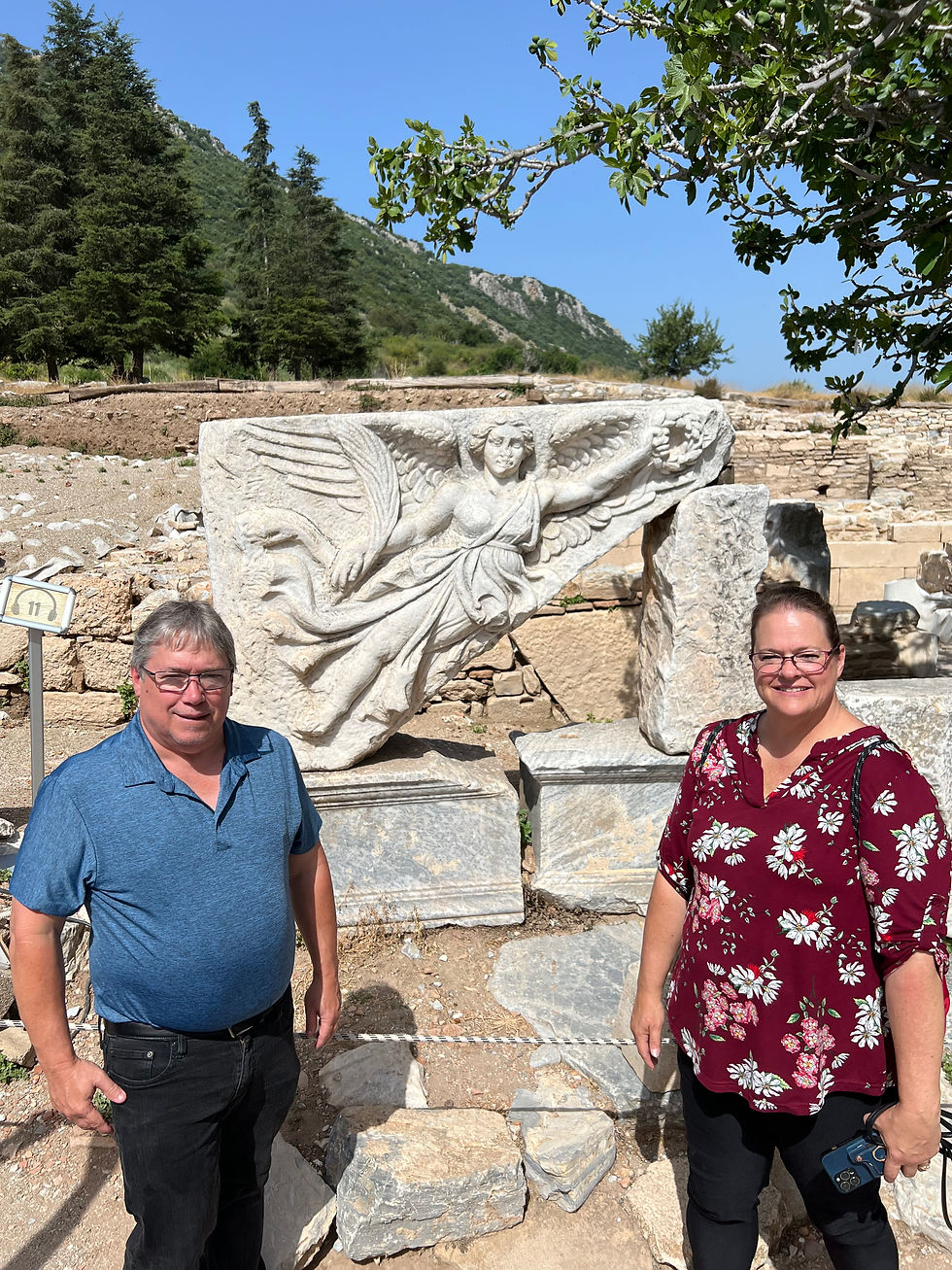

Along Curetes Street, the Temple of Hadrian stands with its curved arch and carved relief of Nike, the winged goddess of victory, still remarkably intact after all these centuries. Nearby, the Gate of Mazeus and Mithridates, built by two freed slaves as a tribute to Emperor Augustus, shows just how personal these monuments could be. It's one thing to read about Roman patronage in a book. It's another to stand under an arch built by two men who were once slaves and became wealthy enough to build a gate to an emperor.
The Latrines

No visit to Ephesus is complete without a stop at the ancient public latrines, a long row of marble seats set side by side with no partitions in between. Valkan explained that this was a social space as much as a practical one. Wealthy Ephesians would sit and chat while conducting their business, sometimes even sending servants ahead to warm the seats. It's the kind of detail that sticks with you long after the grand columns and temples start to blur together.
Ancient Advertising, Carved in Stone

One of the more colorful stops along the way was a slab set right into the marble paving, worn smooth by two thousand years of sandals and now tourist sneakers. Carved into it is a left foot, a woman's head, a heart, and a small hole. Valkan grinned as he explained it: this was Ephesus's version of a billboard, an ancient advertisement pointing the way to the city's brothel, conveniently located near the library and the harbor. The foot indicated the direction to walk, the woman's head and heart made the offer clear, and travelers have debated for years what the hole itself measured or symbolized. Whatever the exact meaning, the message was unmistakable then, and it still gets a laugh out of every tour group that stops to look down and puzzle it out today. It's a small reminder that beneath all the marble grandeur, Ephesus was a real city full of real people, complete with all the same appetites we have now.
The Library of Celsus

And then there's the Library of Celsus, the postcard image of Ephesus and for good reason. The two-story facade, with its carved niches and statues representing Wisdom, Knowledge, Virtue, and Excellence, rises up at the end of the marble street like the city's grand finale. Once home to thousands of scrolls, it was one of the great libraries of the ancient world, and standing in front of it, you understand immediately why every tour photo from Ephesus looks the same. Some views earn the repetition.
A City Worth the Walk
By the time we made our way back toward the entrance, past crowds of fellow travelers and a modern-day crane working somewhere off in the distance, a reminder that this ancient site is still being carefully excavated and preserved, we understood why Ephesus is considered one of the best-preserved ancient cities in the Mediterranean. It's not just the scale of what's still standing. It's the way a good guide can turn stone into story.
Lunch, Turkish Style

After a morning of ruins and history, Valkan led us to a local restaurant for a proper Turkish meal, and it turned out to be one of the highlights of the day in its own right. The table filled up fast: little dishes of roasted beets, carrot salad, warm bread, and small plates of meze to pick at before the main courses even arrived. Then came grilled meats with rice and a thick wedge of tomato, all of it simple, fresh, and clearly made with care. Add a glass of local white wine and a slow lunch under the shade, and it was the perfect midday reset before the afternoon stops.
An Impromptu Stop at an Ancient Mosque
One of the best parts of touring with a good local guide is the stops that aren't on the printed itinerary. Valkan pulled us aside for a quick visit to one of the oldest mosques in the region, a small, unassuming building that had clearly stood for centuries. We couldn't go inside, but he let us step up to the doorway and look in, pointing out details of the architecture and explaining a bit of the building's history. It was a quiet, respectful moment, a reminder that this part of Turkey has layers of history stacked on top of each other, Greek, Roman, and Ottoman, all within walking distance of one another.
The Pottery Shop

Next up was a stop at a local pottery shop, where rows of hand-painted plates, bowls, and vases lined the walls in every color imaginable. The craftsmanship was impressive, and it was clear that these weren't mass-produced souvenirs but genuine handmade pieces, each one slightly different from the next. Even without buying anything, it was worth the stop just to see the work up close.
Watching the Rug Makers
The last stop of the day was a rug-making demonstration, and this is the one that stuck with us the most. Yes, there was a sales pitch waiting at the end, and yes, the rugs on display carried a price tag to match the work that went into them. But before any of that, we got to watch a small group of women working at a loom, tying and knotting individual threads by hand, one at a time, to build a pattern that would eventually become a rug worth thousands of dollars. Seeing that patience and precision in person puts the price into perspective. These aren't machine-made goods. They're hours upon hours of skilled, painstaking handwork, and my wife and I both agreed that watching it happen made the sales pitch a lot easier to sit through.
Thanks to Valkan for bringing it all to life, and thanks to Kuşadası for the warm welcome back to the ship afterward. For my wife and me, this is the day that became the inspiration behind Beneath Mediterranean Skies, Book 2 in the Uncharted Horizons series, and the Kuşadası and Ephesus leg of Lance and Olivia's journey. Look for it on Amazon starting October 1st.

Comments